Posts

Ethiopian Background Update
Image
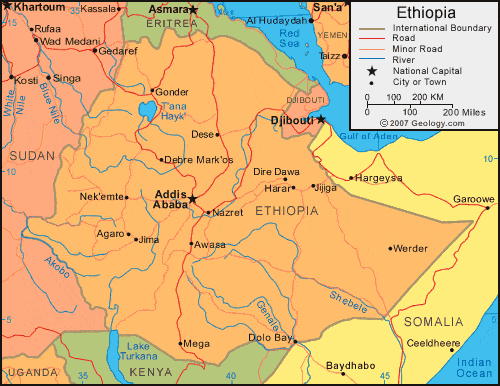
It’s occurred to me that since my decision to focus on Ethiopia I haven’t really given much general information about the country. However, I think it will be really useful for putting the challenges and possible solutions that I’ll be discussing into context. So here’s a quick background update on Ethiopia:   Despite being influenced by processes in the Indian Ocean, Ethiopia is a landlocked nation (see Figure 1 ). It has the second largest population of any African country , behind Nigeria, yet it is also one of the most poverty stricken with a per capita income of just $660 . Agriculture makes up almost  50% of the country’s GDP , most of which centres on small-scale rain-fed crops and livestock rearing, and is growing at 5% per year . Economic growth averaging 10.5% per year from 2005/6 to 2015/16 has, however, reduced extreme poverty levels from 55.3% in 2000, to 33.5% in 2011 . Alongside this, in the last 20 years Ethiopia has seen a marked improvement in a number o...

Anthropogenic Food Insecurity in Ethiopia

Image
Last week , I highlighted the role that global natural phenomena play in influencing Ethiopia’s rainfall patterns. However, there are other factors putting pressure on Ethiopia’s food supply and whilst not all directly water based, it is important to have a complete understanding of the challenges facing Ethiopia’s food and water relationship. This week I’ll be looking at the impact of general warming, the long-term decline in precipitation experienced in parts of Ethiopia and the significance of the nation’s rapidly growing population.   Ethiopia, as with the rest of the globe, is experiencing anthropogenic warming and an average one-degree temperature rise is expected in the imminent future (see Figure 1 ). It is likely that this rise will result in the intensification of the natural cycles that I discussed last week, with rainfall events becoming more extreme, but less frequent, with a 40% increase in the frequency of droughts . This will exacerbate both periods of drough...

Ethiopian Precipitation Cycles

Image
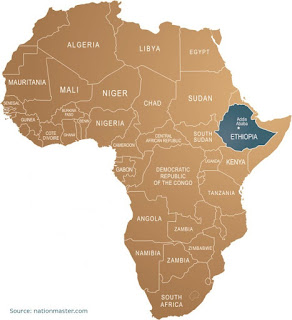
Sorry readers! It’s been a while since my last post, but whilst I’ve been away I have been taking a look at the extraordinary situation of Ethiopia, on the east coast of Africa (see Figure 1). The pressures facing Ethiopia’s agricultural production are extreme and highlight well the precarious relationship between food and water across much of Africa. I will therefore be   focusing on Ethiopia throughout my blog. This week I will discuss some of the cyclical water-related issues facing Ethiopian agriculture before highlighting long-term and anthropogenic problems posing a threat to Ethiopia’s food security in my next post. Future posts will then explore the potentially devastating impact of these cycles and changes on food availability, before taking a look at some of the solutions that have and could be employed to combat Ethiopia’s chronic food insecurity.    Figure 1: Location of Ethiopia                  ...

Intensifying Rainfalls in Sierra Leone

A recent clip from Channel 4’s ‘ Unreported World: Africa’s Perfect Storm ’ surfaced on my Facebook news feed today and I felt I couldn’t let the tragedy go unreported on my own blog. The episode focused on the mudslide in Sierra Leone that destroyed the town of Regent on the outskirts of the capital, Freetown, on the 14th August. Despite being the deadliest natural disaster this year, with over 1000 deaths, the events were followed by a series of devastating storms in the Caribbean and North America and went largely unreported. Whilst not directly related to the food aspects of this blog, the tragic events bring the issues discussed last week sharply into focus. The mudslide was caused by torrential rainfall, in a country that is forced to import 90% of its food, largely due to a lack of water storage during the dry season. These stark figures highlight just how extreme inter-annual rainfall can be across Africa, with food insecurity perhaps not a result of annual water sh...

Introduction: Water, Africa and the Great Misconception

There remains a common misconception, or what could even be labelled a blanket stereotype, within popular discourse that Africa is a dry and arid continent with a dramatic shortage of freshwater. You only have to stumble across a charity advert   on the evening television to see continuous portrayals as Africa and it’s people as teetering on the edge of devastating drought. Whilst the water-based problems seen in these representations are indeed very real across parts of the continent, with a staggering 300 of the 800 million people living in Africa in 2014 suffering from water scarcity , the problems go beyond that of a simple story of too little water.   The traditional metrics of water scarcity have been increasingly criticised in recent years due to their oversight of variations in rainfall and run-off patterns. Alongside this, they fail to take into account groundwater storage, which constitutes 51% of renewable freshwater resources in Africa, and green water, whi...